
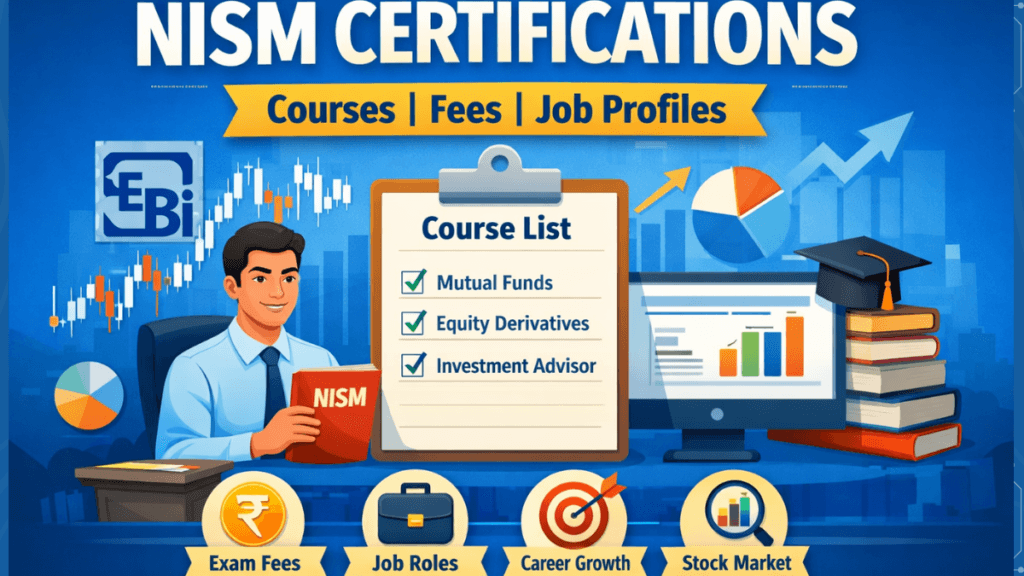
If you want to build a career in the stock market, mutual funds, investment advisory, or financial planning, you may have heard about NISM certifications. These certifications are issued by the National Institute of Securities Markets and are recognized by SEBI (Securities and Exchange Board of India).
In this guide, you will learn what NISM certifications are, the complete course list, fees, eligibility, and job opportunities after completing them. Whether you are a student after 12th, a finance enthusiast, or someone who wants to start a career in the financial markets, this article will help you understand everything step by step.
What Is NISM Certifications?
NISM certifications are professional exams conducted by the National Institute of Securities Markets (NISM), an educational initiative of SEBI. These certifications are designed to improve knowledge and professional standards in the Indian financial market.
Many financial roles in India require NISM certification as a mandatory qualification.
These certifications cover areas such as:
- Stock market trading
- Mutual funds distribution
- Investment advisory
- Research analysis
- Risk management
- Compliance in financial markets
The goal of NISM is to ensure that people working in financial markets have proper knowledge, ethics, and regulatory understanding.
Why NISM Certifications Matter for Investors
NISM certifications are not only useful for professionals but also valuable for individual investors who want deeper knowledge of financial markets.
Benefits of NISM Certifications
- Recognized by SEBI and financial institutions
- Improves knowledge of investing and risk management
- Required for many stock market jobs
- Helps in starting your own financial advisory business
- Builds credibility and trust with clients
Many banks, brokerage firms, mutual fund companies, and financial advisory firms prefer or require employees to have specific NISM certifications.
Real-Life Example or Scenario
Suppose someone wants to become a mutual fund distributor.
Without certification, they cannot legally sell mutual funds.
But after clearing NISM Series V-A: Mutual Fund Distributor Certification, they can register with AMFI and start earning commissions by helping investors choose mutual funds.
For example:
If an advisor manages ₹1 crore of client investments and earns 1% annual trail commission, they could earn around:
₹1,00,000 per year
As their client base grows, their income can grow significantly.
NISM Certification Courses List and Fees
Below is a simplified list of popular NISM certifications and exam fees.
1. NISM Series I – Currency Derivatives Certification
Fees: ₹1500
Job Profile: Currency trader, derivatives dealer
2. NISM Series II-A – Registrar & Transfer Agent (Mutual Fund)
Fees: ₹1500
Job Profile: Back office roles in mutual fund companies
3. NISM Series III-A – Securities Intermediaries Compliance
Fees: ₹1500
Job Profile: Compliance officer in brokerage firms
4. NISM Series IV – Interest Rate Derivatives
Fees: ₹1500
Job Profile: Fixed income trader or analyst
5. NISM Series V-A – Mutual Fund Distributor
Fees: ₹1500
Job Profile: Mutual fund advisor or distributor
6. NISM Series VI – Depository Operations
Fees: ₹1500
Job Profile: DP executive in NSDL/CDSL
7. NISM Series VII – Securities Operations and Risk Management (SORM)
Fees: ₹1500
Job Profile: Stock broker operations, risk management
8. NISM Series VIII – Equity Derivatives Certification
Fees: ₹1500
Job Profile: F&O trader, derivatives dealer
9. NISM Series IX – Merchant Banking
Fees: ₹1500
Job Profile: Investment banking and IPO advisory
10. NISM Series X-A / X-B – Investment Adviser Certification
Fees: ₹2000 each
Job Profile: SEBI Registered Investment Advisor (RIA)
11. NISM Series XV – Research Analyst
Fees: ₹2000
Job Profile: Equity research analyst
12. NISM Series XVI – Commodity Derivatives Certification
Fees: ₹1500
Job Profile: Commodity trader or analyst
Most NISM exams are online and computer-based and conducted through NSE testing centers across India.
Eligibility for NISM Certifications
The good news is that many NISM certifications have no strict age or degree requirements.
Typical eligibility includes:
- Minimum 18 years old
- Basic understanding of financial markets
- Some certifications require graduate qualification for regulatory roles
Students can start learning about the stock market even after 12th standard.
Strategies or Steps to Apply NISM Certifications
If you want to build a career in the financial markets, here are the steps:
- Decide which career path you want
(trading, mutual funds, advisory, research) - Choose the relevant NISM certification exam
- Register on the NISM certification portal
- Pay the exam fee and schedule the test
- Prepare using official NISM study material
- Clear the exam and obtain your certificate
Pro Tips / Mistakes to Avoid
1. Choosing the wrong certification
Many beginners randomly pick exams. Instead, select the one aligned with your career goal.
2. Ignoring regulatory requirements
Some financial jobs require specific certifications to legally operate.
3. Not renewing certification
Most NISM certifications are valid for 3 years, after which renewal is required.
4. Studying only theory
Combine theory with practical market observation and analysis.
Expert Insights or Data
According to financial industry estimates:
- India has over 14 crore demat accounts.
- The mutual fund industry exceeds ₹50 lakh crore AUM.
- The demand for qualified financial advisors and market professionals continues to grow.
As more people enter the stock market, the need for trained professionals with NISM certifications is expected to increase.
Related Topics You Can Explore
- Read also: Can You Earn from the Stock Market After 12th? A Complete Guide to NISM Certifications
- Read also: ₹500 SIP Revolution: Young Indians Building Wealth
Conclusion
NISM certifications provide a structured pathway to enter the financial services industry in India. Whether you want to work in stock broking, mutual funds, investment advisory, or financial research, these certifications help build credibility and professional knowledge.
The best part is that many NISM courses are affordable and accessible even for beginners. With proper preparation and the right certification, you can open doors to job opportunities, advisory services, or even your own financial consulting practice.
Before choosing a certification, understand your career goals and the regulatory requirements. Learning continuously and gaining practical experience will help you grow in the financial markets.
How to Start with NISM Certifications
- Visit the official NISM certification website
- Select the certification relevant to your career goal
- Register and pay the exam fee online
- Study using official NISM material and practice tests
- Clear the exam and receive your certification
Tip: Start with Mutual Fund Distributor or Equity Derivatives certification if you are new to the financial markets.
FAQs About NISM Certifications
Q1. Can I do NISM certification after 12th?
Yes, many NISM certifications do not require a college degree, so students can start learning about financial markets after completing 12th.
Q2. What is the cost of NISM certification?
Most NISM exams cost between ₹1500 and ₹2000, making them affordable compared to many professional finance courses.
Q3. Which NISM certification is best for beginners?
Popular beginner certifications include NISM Mutual Fund Distributor (Series V-A) and Equity Derivatives (Series VIII).
Q4. Is NISM certification mandatory for stock market jobs?
Yes, several roles in stock broking, mutual fund distribution, investment advisory, and research require specific NISM certifications as per SEBI regulations.