
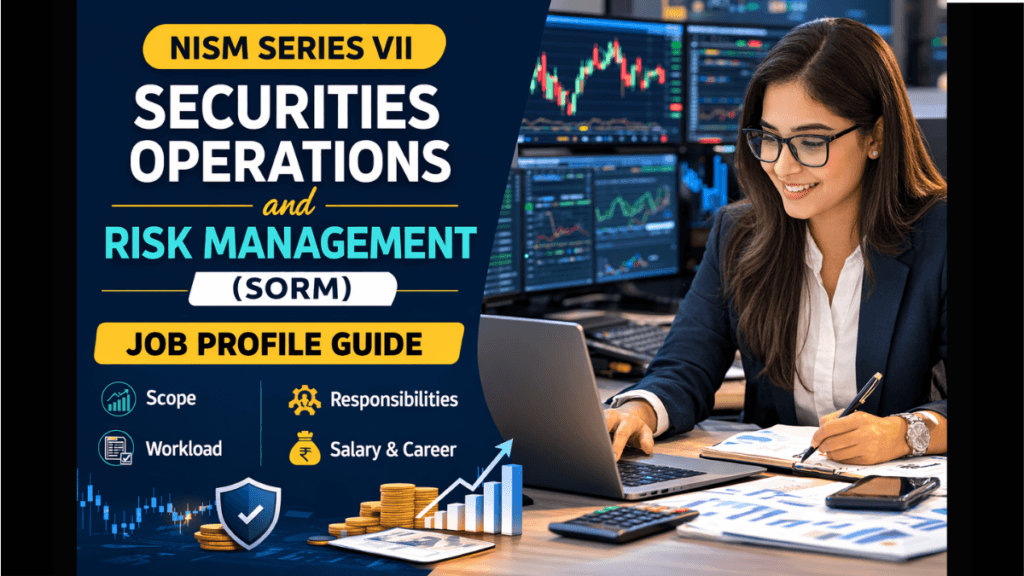
If you want to build a career in the stock market without actively trading, the NISM Series VII SORM job profile can be an excellent option. This certification focuses on securities operations, trade settlements, and risk management in financial markets.
Professionals with this certification typically work with stock brokers, clearing corporations, and financial institutions. In this article, you will learn about the NISM Series VII SORM job profile, responsibilities, workload, salary potential, and career scope in India.
What Is NISM Series VII – Securities Operations and Risk Management (SORM)?
The NISM Series VII – Securities Operations and Risk Management (SORM) certification is offered by the National Institute of Securities Markets (NISM) under SEBI guidelines.
This certification is mainly designed for professionals working in back-office operations, compliance, and risk management within stock brokerage firms.
It focuses on key areas such as:
- Trade lifecycle and settlement processes
- Clearing and settlement mechanisms
- Risk management in the stock market
- Regulatory framework in securities markets
- Operational controls and compliance
In simple terms, the certification prepares candidates to manage the operational and risk aspects of stock market transactions.
Why NISM Series VII SORM Job Profile Matters for Investors
Although SORM professionals usually work behind the scenes, their role is crucial in maintaining the integrity and safety of the financial system.
They ensure:
- Trades are settled correctly
- Investor funds and securities are handled safely
- Market risks are monitored
- Compliance with SEBI regulations
Without proper securities operations and risk management, stock markets could face operational failures or settlement delays.
Real-Life Example or Scenario
Imagine an investor buys 100 shares of a company at ₹500 each.
Total trade value:
₹500 × 100 = ₹50,000
Behind the scenes, the following processes must happen smoothly:
- Trade confirmation
- Clearing through clearing corporations
- Settlement through depositories
- Funds transfer between parties
A SORM professional ensures these processes are executed correctly and any operational risk is minimized.
NISM Series VII SORM Job Responsibilities
The NISM Series VII SORM job profile mainly involves managing the operational aspects of securities trading.
Common responsibilities include:
- Monitoring trade execution and settlement cycles
- Managing clearing and settlement operations
- Ensuring compliance with SEBI and exchange regulations
- Handling risk management processes
- Managing client account operations
- Monitoring margin requirements
- Preparing operational reports and documentation
- Identifying and minimizing operational risks
These professionals usually work in brokerage firms, clearing members, banks, and financial institutions.
NISM Series VII SORM Job Workload
The workload in this role is generally moderate but detail-oriented.
Typical work characteristics include:
- Office-based work environment
- Data verification and transaction monitoring
- Interaction with brokers, exchanges, and clearing corporations
- Handling settlement deadlines
During market closing or settlement periods, the workload may increase slightly because trades must be processed accurately.
However, compared to trading roles, this job is usually less stressful and more process-driven.
Career Scope of NISM Series VII SORM Certification
The demand for professionals with securities operations and risk management expertise is growing as the Indian financial markets expand.
Career opportunities include:
- Stock brokerage firms
- Clearing corporations
- Depository participants
- Banks and NBFCs
- Financial service companies
- Investment firms
Common job roles include:
- Securities Operations Executive
- Risk Management Analyst
- Settlement Officer
- Compliance Assistant
- Back Office Operations Executive
With experience, professionals can move into senior risk management or compliance roles.
NISM Series VII SORM Salary in India
Income depends on experience, organization, and city.
Typical salary ranges are:
Entry-Level (0–2 years)
₹2.5 lakh – ₹4 lakh per year
Mid-Level (3–6 years)
₹4 lakh – ₹8 lakh per year
Senior Roles (7+ years)
₹8 lakh – ₹15 lakh+ per year
Large financial institutions or stock brokerage companies may offer higher salary packages along with performance bonuses.
Strategies or Steps to Apply NISM Series VII SORM Career
If you want to pursue this career path, follow these steps.
- Complete the NISM Series VII SORM certification
Register through the NISM certification portal. - Learn stock market operations
Understand clearing, settlement, and regulatory processes. - Develop analytical and compliance skills
Risk monitoring requires strong attention to detail. - Apply to financial institutions
Look for opportunities in brokerage firms, banks, and clearing members. - Gain experience in operations or compliance roles
Experience helps move into higher-paying risk management positions.
Pro Tips / Mistakes to Avoid
Common mistakes beginners make include:
- Ignoring operational knowledge of the stock market
- Not understanding SEBI regulations
- Focusing only on trading instead of operations
- Overlooking risk management concepts
Pro tips:
- Learn the trade lifecycle thoroughly
- Stay updated with SEBI regulations and compliance rules
- Build skills in financial data analysis and reporting
Expert Insights or Data
India’s capital market ecosystem has expanded significantly in recent years.
Key observations include:
- Over 13+ crore demat accounts exist in India.
- Daily stock market turnover regularly crosses ₹70,000 crore.
- Brokerage firms require qualified operations and risk management professionals to manage this volume.
Because of this growth, certifications like NISM Series VII SORM are becoming increasingly valuable for professionals entering the financial services industry.
Related Topics You Can Explore
- Read also: NISM Series V-A Mutual Fund Distributor: Job Profile, Scope, Workload & Income
- Read also: NISM Certifications: Complete Course List, Fees, and Job Profiles
Conclusion
The NISM Series VII SORM job profile offers a stable and structured career in the financial services industry. While traders focus on buying and selling securities, SORM professionals ensure that operations, settlements, and risk management systems function smoothly.
This certification is particularly useful for individuals who want to work in stock market operations, compliance, or risk management rather than active trading.
If you are interested in the financial markets and prefer a process-driven, analytical role, the NISM Series VII certification can open doors to several opportunities in brokerage firms, banks, and financial institutions.
Before choosing this career path, it is important to learn the fundamentals, gain practical exposure, and stay updated with market regulations.
How to Start with NISM Series VII SORM Certification
- Visit the official NISM certification website.
- Register for the NISM Series VII – Securities Operations and Risk Management exam.
- Study the syllabus covering settlement systems, risk management, and regulatory frameworks.
- Pass the certification exam and apply for operations or compliance roles in financial institutions.
FAQs About NISM Series VII SORM Job Profile
Q1. What is NISM Series VII SORM certification?
A1. It is a certification that focuses on securities operations, clearing, settlement processes, and risk management in the stock market.
Q2. Who should take the NISM Series VII exam?
A2. Individuals interested in stock market operations, brokerage back-office roles, compliance, or risk management should consider this certification.
Q3. Is NISM Series VII mandatory for stock market jobs?
A3. Many brokerage firms prefer or require this certification for employees handling securities operations and risk management activities.
Q4. What is the validity of NISM Series VII certification?
A4. Like most NISM certifications, it is typically valid for 3 years, after which renewal or continuing education requirements may apply.