Is Buying Both CE and PE Always Profitable? The Truth About Straddles
Hey there, fellow investor! Remember that time I nervously watched Nifty swing wildly before a budget announcement? I was tempted to buy both a Call Option (CE) and a Put Option (PE) at the same strike price—classic straddle strategy. Sounded like a sure win if the market moved big, right? Spoiler: It wasn't. Let's unpack why buying both CE and PE isn't always profitable, using simple stories and rupee math tailored for us Indians.
What’s a Straddle Strategy, Anyway? (Beginner Breakdown)
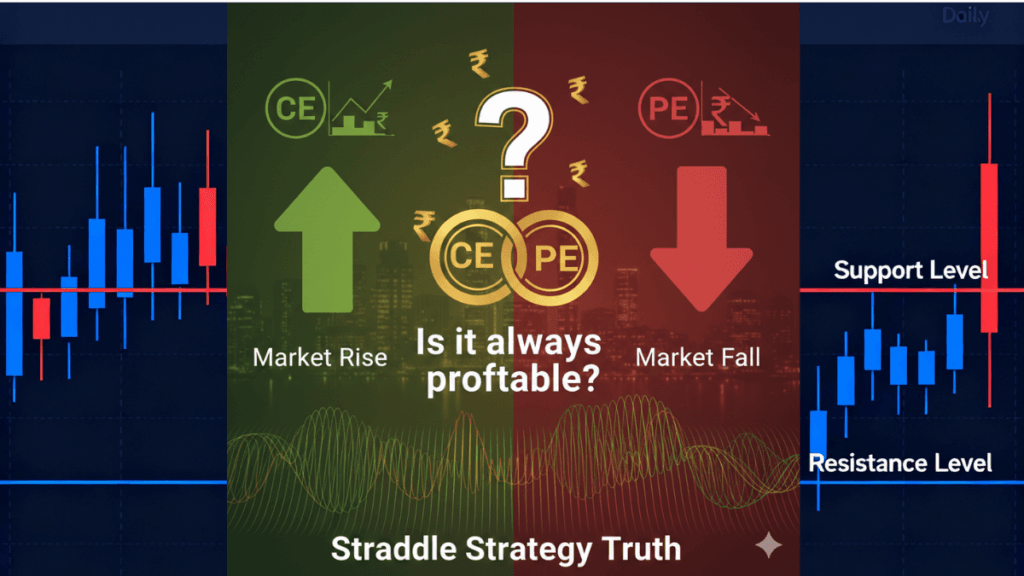
Imagine you're at a Mumbai street food stall, betting on whether the next dish will be too spicy (market falls) or perfectly mild (market rises). A straddle strategy is like placing bets on both outcomes. You buy:
- A Call Option (CE): Profits if the stock/index rises.
- A Put Option (PE): Profits if it falls.
Both at the same strike price and expiry. It's a bet on high volatility—big moves in any direction.
Analogy time: Like insuring your bike for both accident and theft. Premiums (option prices) eat your pocket upfront, but payout only if disaster strikes big.
SEBI Disclaimer: Options trading involves substantial risk of loss and is not suitable for all investors. Past performance doesn't guarantee future results. Consult a SEBI-registered advisor before trading.
My First Straddle Fiasco: A Real-Life Case Study
Back in 2022, pre-Union Budget hype, Nifty was at 17,000. I bought a straddle: ₹150 CE + ₹140 PE = ₹290 total premium (lot size 50, so ₹14,500 outlay).
- Budget day: Nifty jumped to 17,500. CE doubled to ₹300 profit (₹7,500 gain), but PE expired worthless (-₹7,000). Net loss: ₹500 after costs.
- Why? Volatility spiked, but direction was predictable. Straddle loves uncertainty, not one-way bets.
Lesson from behavioral finance: We chase “volatility wins” due to FOMO, ignoring time decay (theta). Options lose value daily if the market sits still.
When Straddles Work (And When They Don't)—Data-Backed Truth
Straddles shine in high-volatility events like earnings or elections, but flop otherwise. Here's the math:
| Scenario | Nifty Move | CE Gain/Loss (₹) | PE Gain/Loss (₹) | Net (after ₹290 premium) |
|---|---|---|---|---|
| Big Up (500 pts) | +3% | +₹5,000 | -₹7,000 | -₹2,290 (loss) |
| Big Down (500 pts) | -3% | -₹7,000 | +₹5,000 | -₹2,290 (loss) |
| Huge Move (1,000 pts) | ±6% | +₹12,000 | -₹7,000 (or vice versa) | +₹4,710 (profit) |
Source: Derived from NSE option chain data (hypothetical for education).
In India, 80% of retail traders lose money on derivatives (SEBI data). Straddles amplify this—premiums often exceed profits unless volatility explodes 2x+.
Indian example: During 2024 Lok Sabha results, volatility (India VIX) hit 25+. Straddlers won big (₹20,000+ per lot on wild swings). But post-event? Decay wiped many out.
How to Approach Straddles Like a Pro (Step-by-Step Framework)
Don't jump blind. Use this risk management checklist:
- Check Volatility: Buy when India VIX < 15 (cheap premiums). Sell when >25.
- Pick Events: RBI policy, Q4 earnings, or global cues—not daily trades.
- Size Smart: Risk only 1-2% of your portfolio (e.g., ₹10,000 on ₹5 lakh capital).
- Exit Rules: Cut losses at 30% premium erosion; take profits at 50% gain.
- Alternatives: Try strangle (different strikes, cheaper) or iron condor for range-bound markets.
Pro tip: Paper trade on Sensibull first. It's like test-driving a scooter before buying.
The Indian Investor's Philosophy: Volatility Isn't Your Friend
In our Desi markets, influenced by monsoons, budgets, and global masala, we love high-beta plays. But behavioral traps like overconfidence lead to “straddle addiction.” Remember, Warren Buffett skips options—focus on long-term investing or SIPs in Nifty ETFs for steady wealth.
Cultural angle: Like betting on IPL matches, thrill is fun, but bookies (brokers) always win long-term. Build financial planning with mutual funds first.
Wrapping Up: Straddles Aren't a Magic Bullet
Buying both CE and PE via straddles isn't “always profitable”—it demands massive moves to beat premiums and decay. Great for volatile events, risky otherwise. Start small, educate yourself, and prioritize risk management in your stock market journey.
CTA: Ready to level up? Explore our free options basics guide or share your straddle story in comments. What's your next trade play?
SEBI Disclaimer: This is educational content, not advice. Derivatives carry high risk; trade at your own discretion.