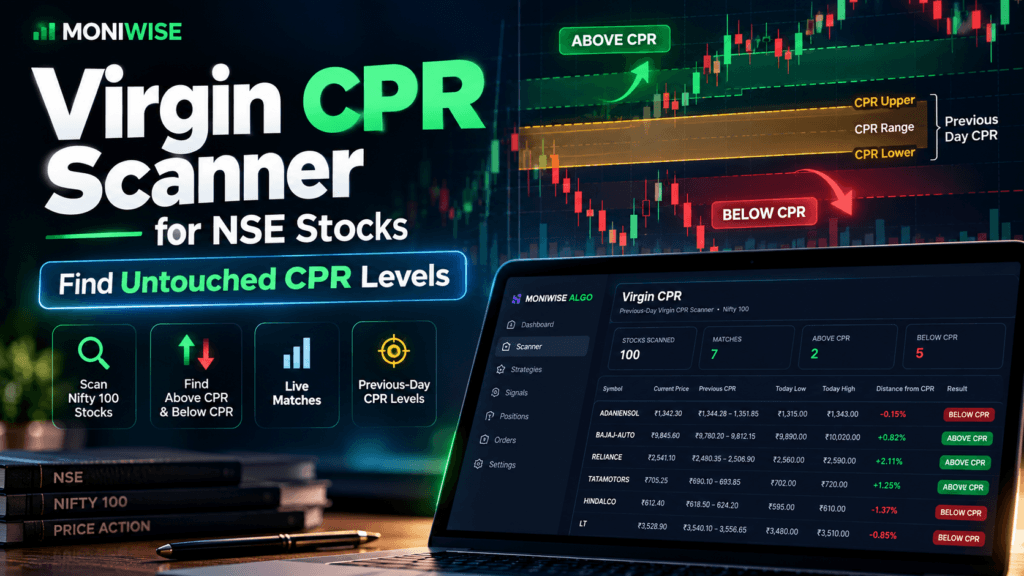
Virgin CPR Scanner for NSE Stocks – Find Untouched CPR Levels
A Virgin CPR Scanner can help traders quickly identify stocks whose previous-day Central Pivot Range (CPR) has remained untouched during the current trading day.
Instead of opening dozens of charts and manually checking CPR levels, the MONIwise Virgin CPR Scanner automatically scans the Nifty 100 universe and identifies stocks whose entire current-day trading range remains either above or below the previous day’s CPR.
The scanner separates results into:
- ABOVE CPR
- BELOW CPR
- NO MATCH
This guide explains what Virgin CPR means, how CPR is calculated, exactly how the MONIwise scanner determines a match, and how traders can interpret the results.
What Is Virgin CPR?
CPR stands for Central Pivot Range.
It is calculated using the previous trading day’s high, low and close and consists of three important values:
- Pivot
- BC
- TC
When the following trading day’s price does not touch or enter the previous day’s CPR range, that previous CPR can be described as untouched or virgin for the purpose of this scanner.
The important distinction is that MONIwise checks the complete CPR range, not just the central Pivot.
For a stock to qualify, its current-day range must remain completely outside the previous day’s CPR.
Check Today’s Virgin CPR Stocks
Rather than manually checking each Nifty 100 chart, use the live scanner to find current matches.
Find Today’s Virgin CPR Stocks
Scan Nifty 100 stocks and quickly find current matches trading completely above or below the previous day’s CPR.
Check Today’s Virgin CPR Stocks →Live scanner • Nifty 100 • Previous-day CPR
How Is CPR Calculated?
The MONIwise scanner first uses the previous trading day’s High, Low and Close.
The central Pivot is calculated as:
Pivot = (Previous High + Previous Low + Previous Close) ÷ 3
The Bottom Central value is:
BC = (Previous High + Previous Low) ÷ 2
The TC value is:
TC = (2 × Pivot) − BC
The scanner then normalizes BC and TC into the actual lower and upper boundaries:
CPR Lower = MIN(BC, TC)
CPR Upper = MAX(BC, TC)
Using lower and upper boundaries is important because the numerical order of the calculated BC and TC values can vary.
The result is a CPR zone rather than simply one Pivot line.
How the MONIwise Virgin CPR Scanner Works
The scanner uses the previous trading day’s CPR and compares it with the complete trading range available for the current day.
There are two ways for a stock to become a match.
1. ABOVE CPR
For an ABOVE CPR match:
Today’s Low > Previous CPR Upper
This is stricter than simply checking whether the current price is above CPR.
Even the lowest price traded during the current day must remain above the previous day’s upper CPR boundary.
For example:
Previous CPR: ₹980 – ₹990
Today’s Low: ₹1,002
Today’s High: ₹1,035
Since:
₹1,002 > ₹990
the entire current-day range remains above the previous CPR.
The scanner can therefore classify the stock as:
ABOVE CPR
2. BELOW CPR
For a BELOW CPR match:
Today’s High < Previous CPR Lower
Even the highest price traded during the current day must remain below the previous day’s lower CPR boundary.
For example:
Previous CPR: ₹1,500 – ₹1,515
Today’s Low: ₹1,455
Today’s High: ₹1,488
Since:
₹1,488 < ₹1,500
the complete current-day range remains below the previous CPR.
The scanner can classify the stock as:
BELOW CPR
What Does NO MATCH Mean?
A stock receives NO MATCH when its current-day trading range does not remain completely above or completely below the previous CPR.
For example:
Previous CPR: ₹750 – ₹760
Today’s Low: ₹755
Today’s High: ₹785
Today’s range has entered the previous CPR because the low of ₹755 falls inside the ₹750–₹760 CPR range.
Therefore, the previous CPR is no longer untouched under the scanner’s conditions.
The result would be:
NO MATCH
Virgin CPR Scanner Conditions at a Glance
The complete scanner logic can be summarized as:
ABOVE CPR
Today’s Low > Previous CPR Upper
OR
BELOW CPR
Today’s High < Previous CPR Lower
If either condition is true, the stock becomes a MATCH.
If neither condition is true, it remains NO MATCH.
This OR logic is important: a stock does not need to satisfy both conditions. It only needs to remain entirely on one side of the previous CPR.
Why Check Today’s Entire Range Instead of Current Price?
This is one of the most important differences between a simple CPR filter and the MONIwise Virgin CPR Scanner.
Imagine:
Previous CPR: ₹500 – ₹510
Today’s current price: ₹530
Looking only at the latest price could make it appear that the stock has remained above CPR.
But suppose today’s low was ₹505.
Price has already traded inside the previous CPR during the day.
Therefore, the CPR was touched even though the latest price is now well above it.
MONIwise instead checks:
Today’s Low > CPR Upper
for an Above CPR result.
And:
Today’s High < CPR Lower
for a Below CPR result.
This allows the scanner to determine whether the entire current-day range available to the system has remained outside the previous CPR.
What Does “Distance from CPR” Mean?
The scanner also displays Distance from CPR.
For an ABOVE CPR stock, distance is measured from the upper CPR boundary.
For a BELOW CPR stock, distance is measured from the lower CPR boundary.
This gives users additional context about where the latest price sits relative to the relevant CPR boundary.
However, a larger distance should not automatically be interpreted as a stronger or better trade.
Distance is descriptive information—not a prediction of future price movement.
How to Read the Virgin CPR Scanner
The live scanner displays several columns:
- Symbol
- Current Price
- Previous CPR
- Today’s Low
- Today’s High
- Distance from CPR
- Result
The Previous CPR column displays the lower and upper boundaries as a range.
For example:
₹1,344.28 – ₹1,351.85
A BELOW CPR stock might then show:
Today’s High: ₹1,343.00
Because ₹1,343.00 is below the lower CPR boundary of ₹1,344.28, the complete current-day range remains below the previous CPR.
The result is therefore:
BELOW CPR
Above CPR vs Below CPR
The scanner deliberately separates the two situations.
ABOVE CPR
The entire current-day trading range remains above the previous day’s CPR.
Condition:
Today’s Low > CPR Upper
BELOW CPR
The entire current-day trading range remains below the previous day’s CPR.
Condition:
Today’s High < CPR Lower
These labels describe price location relative to the previous CPR.
They should not automatically be interpreted as buy and sell recommendations.
Is ABOVE CPR Automatically a Buy Signal?
No.
An ABOVE CPR result means the stock currently satisfies one specific technical condition: its current-day trading range has remained above the previous day’s CPR.
It does not guarantee that:
- price will continue rising,
- a breakout will occur,
- resistance will be broken,
- the stock will close higher,
- or a trade will be profitable.
Likewise, BELOW CPR does not guarantee that price will continue falling.
The scanner is designed to identify a specific market condition so that traders can perform further analysis.
How Traders Can Use a Virgin CPR Scanner
The primary advantage of a scanner is efficiency.
Instead of opening every Nifty 100 chart individually, traders can first narrow the universe to stocks that currently satisfy the Virgin CPR conditions.
A possible research workflow is:
Step 1: Run the Virgin CPR Scanner.
Step 2: Identify ABOVE CPR and BELOW CPR matches.
Step 3: Open the relevant charts.
Step 4: Examine market structure and important price levels.
Step 5: Consider support and resistance.
Step 6: Evaluate volume, broader market context and any other conditions required by your own trading method.
Step 7: Define risk before considering a trade.
The scanner therefore acts as a screening layer, not a replacement for chart analysis or risk management.
Virgin CPR and Support & Resistance
A Virgin CPR result can be more useful when viewed alongside broader chart context.
For example, a stock may remain entirely above its previous CPR while approaching a significant resistance area.
Another stock may remain below CPR but be trading close to an important support level.
The scanner alone doesn’t evaluate every possible support or resistance level.
For more background, read our Support and Resistance Levels guide.
Support and Resistance Levels guide
This creates a more complete research process instead of treating CPR as an isolated signal.
Virgin CPR vs Regular CPR
CPR itself refers to the calculated Central Pivot Range.
A Virgin CPR setup focuses specifically on whether that previous CPR has remained untouched during the current trading period being evaluated.
So the distinction is:
CPR: the calculated Pivot/BC/TC range.
Virgin CPR: a previous CPR that has remained untouched under the scanner’s current-day range conditions.
MONIwise automatically performs this comparison across the Nifty 100 universe.
Why Use a Nifty 100 Virgin CPR Scanner?
Checking stocks manually can become time-consuming.
MONIwise currently focuses the Virgin CPR scanner on Nifty 100 stocks, providing a defined universe rather than attempting to screen every listed security.
This allows users to quickly see:
- how many stocks were scanned,
- how many currently match,
- how many are Above CPR,
- how many are Below CPR,
- and the CPR boundaries used for each stock.
The scanner results can change as new intraday candle data becomes available.
Can a Virgin CPR Setup Fail?
Yes.
A Virgin CPR condition describes what price has done relative to the previous CPR up to the data currently available to the scanner.
It does not predict what happens next.
A stock that has remained above CPR can later decline.
A stock below CPR can reverse upward.
Price can also move into the CPR later in the session, causing the untouched condition to disappear.
Technical conditions should therefore be treated as information—not certainty.
Virgin CPR Scanner vs Stock Tips
There is an important difference.
A stock tip tells someone what they should supposedly buy or sell.
The MONIwise Virgin CPR Scanner instead answers a narrower factual question:
Which Nifty 100 stocks currently satisfy the programmed Virgin CPR conditions?
A MATCH means the scanner’s rules are satisfied.
It does not mean:
- guaranteed profit,
- confirmed breakout,
- guaranteed reversal,
- target achieved,
- buy recommendation,
- or sell recommendation.
Users should independently evaluate any scanner result before making financial decisions.
Check Today’s Virgin CPR Matches
The live MONIwise scanner calculates the previous day’s CPR and compares it with the current-day range across the Nifty 100 universe.
It then separates qualifying stocks into:
ABOVE CPR
and
BELOW CPR
so you don’t have to manually inspect every stock.
Ready to Check Today’s CPR Matches?
View stocks currently matching the Above CPR or Below CPR conditions in the MONIwise Virgin CPR Scanner.
Open Free Virgin CPR Scanner →Frequently Asked Questions
What is a Virgin CPR Scanner?
A Virgin CPR Scanner identifies stocks whose previous-day Central Pivot Range has remained untouched according to defined current-day price conditions. The MONIwise scanner checks whether the entire current-day range remains above or below the previous CPR.
What is the formula for CPR?
The scanner calculates:
Pivot = (Previous High + Previous Low + Previous Close) ÷ 3
BC = (Previous High + Previous Low) ÷ 2
TC = (2 × Pivot) − BC
It then uses the minimum and maximum of BC and TC as the lower and upper CPR boundaries.
What makes CPR virgin in the MONIwise scanner?
For an Above CPR match, today’s Low must remain above the previous CPR Upper boundary.
For a Below CPR match, today’s High must remain below the previous CPR Lower boundary.
If today’s trading range touches or enters the previous CPR, the stock does not qualify as an untouched CPR match.
What does ABOVE CPR mean?
ABOVE CPR means the current day’s lowest traded price available to the scanner remains above the previous day’s upper CPR boundary.
What does BELOW CPR mean?
BELOW CPR means the current day’s highest traded price available to the scanner remains below the previous day’s lower CPR boundary.
Does ABOVE CPR mean I should buy the stock?
No. ABOVE CPR describes the stock’s current price location relative to the previous CPR under the scanner’s rules. It is not, by itself, a buy recommendation.
Does BELOW CPR mean I should short the stock?
No. BELOW CPR identifies a technical price-location condition. It does not by itself constitute a short or sell recommendation.
Which stocks does the MONIwise Virgin CPR Scanner scan?
The current scanner is designed around the Nifty 100 stock universe.
Is the MONIwise Virgin CPR Scanner free?
The Virgin CPR scanner is currently available through MONIwise as a stock-screening tool.
Final Thoughts
A Virgin CPR Scanner can save considerable time when the goal is to find stocks whose previous-day Central Pivot Range has remained untouched during the current session.
Rather than simply comparing the latest price with the central Pivot, the MONIwise scanner evaluates the complete previous CPR range.
The core logic is straightforward:
Today’s Low > CPR Upper
OR
Today’s High < CPR Lower
Stocks satisfying either condition become matches.
From there, traders can examine the chart, support and resistance, broader market context, volume and their own risk-management criteria before making any trading decision.
The purpose of the scanner is not to predict the next move. It is to make finding a specific technical setup faster and more systematic.
Disclaimer: MONIwise scanners and educational content are provided for informational and educational purposes only. Scanner matches are based on programmed technical conditions and should not be considered investment, trading, buy, sell or hold recommendations. Market conditions can change rapidly, and technical setups do not guarantee future performance. Conduct your own research and consider your financial circumstances and risk tolerance before making investment or trading decisions.