
Still Using Trading Bots? SEBI’s 2026 Algo Rules Could Cost You Big
If you run a Python script through your broker’s API, subscribe to a ready-made algo, or follow an “auto-trading bot” sold on Telegram or Instagram, the rules have changed. Since 1 April 2026, SEBI’s retail algo trading framework is mandatory for every stockbroker in India.
Here is the important part: algo trading is not banned. The real risk is quieter. A setup that worked fine last year can now see its orders rejected, or leave you dependent on a seller who is not allowed to offer that strategy at all.
This guide explains the SEBI algo trading rules 2026 in simple words, shows who is most at risk, and gives you a checklist to stay safe.
Quick answer: Is algo trading legal for retail traders in India in 2026?
Yes. Retail algo trading is legal, but it now has to run inside a regulated structure:
- Orders must go through your broker’s approved API
- Your API access must be tied to a whitelisted static IP
- Every algo order is tagged with an Algo ID
- “Black box” strategies can only be offered by registered providers with a SEBI Research Analyst licence
What are SEBI’s new algo trading rules for retail traders?
The framework comes from SEBI’s circular of 4 February 2025 on the safer participation of retail investors in algorithmic trading. NSE and BSE then issued the technical standards that brokers must follow.
Rollout was delayed more than once, and the timeline ended up like this:
- 31 October 2025: brokers had to register at least one retail algo product with the exchanges
- 30 November 2025: registration of other API-based products and strategies
- 3 January 2026: at least one mock trading session under the new rules
- 5 January 2026: brokers who missed these milestones could not onboard new retail API clients
- 1 April 2026: full framework applicable to all stockbrokers
SEBI also revised the Order-to-Trade Ratio (OTR) framework through a circular dated 4 February 2026, effective 6 April 2026. Ask your broker how this applies to your trading pattern.
5 SEBI algo rules that can hurt you if you ignore them
1. Your API must use a whitelisted static IP
An algo can no longer fire orders from any random network. Your broker whitelists a static IP (usually one or two) for your API key, so every order can be traced back to you or your algo provider.
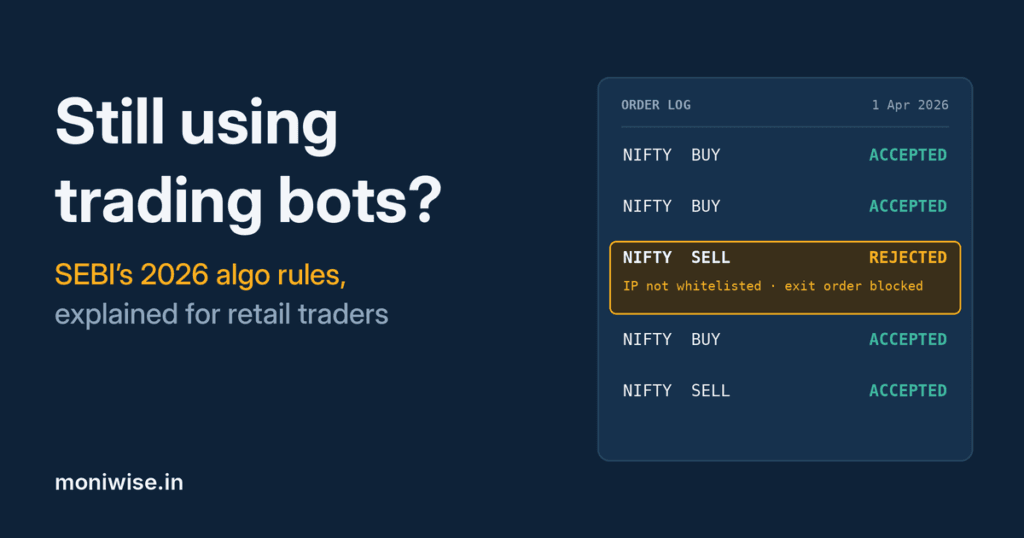
Where traders get hurt: running a script from home broadband with a changing IP, a mobile hotspot, or a cloud server without a fixed IP. Orders from a non-whitelisted IP can simply be rejected. NSE allows a static IP to be shared among family members, but only with written consent or a 2FA-validated request to the broker.
2. The 10 orders per second (OPS) threshold
Exchanges set a threshold of 10 orders per second, per exchange, per segment. Most retail strategies stay far below this.
- Below the threshold: you are treated as a regular API user and do not need to register your strategy with the exchange
- Above the threshold: the strategy must be registered with the exchange through your broker and gets a unique Algo ID
Brokers are expected to monitor and block orders that cross the limit, and they may apply stricter limits of their own.
3. Every algo order gets tagged (Algo ID)
Orders from algos carry an Algo ID. Registered strategies get a unique ID, while orders from unregistered API usage below the threshold carry a generic one. This creates an audit trail, so regulators can see which orders were automated and who is responsible.
4. White box vs black box: the rule that matters most
- White box (execution algos): the logic is transparent and fixed, such as simple order slicing tools. These are easier to approve.
- Black box: the logic is hidden from you. The provider must register as a SEBI Research Analyst (RA), hold exchange empanelment, and maintain research reports and audit records.
If you pay for a “guaranteed profit bot” whose logic is secret and the seller has no RA registration or exchange empanelment, you are taking on risk the framework was designed to remove. You also have far less recourse if something goes wrong.
5. Brokers are now accountable, with stronger security
Brokers must do due diligence on every algo provider they onboard, and they are responsible for what passes through their systems. The framework also requires stricter authentication (including 2FA) and audit trails. In practice, expect more verification steps and fewer shortcuts when connecting a new tool.
Find Current Bullish Momentum Matches
Scan Nifty 100 stocks for 4/4 matches using EMA200, VWAP, the ₹200 filter and our previous-day volatility trigger.
Open Bullish Momentum Scanner →Nifty 100 • 15-Minute Data • 4-Condition Scan
Who is most at risk?
- Users of third-party “auto-trading” bots sold through social media, where registration status is unclear
- Traders who share API keys with friends, vendors or unknown platforms
- Self-coders running scripts from changing IPs or unmanaged cloud servers
- Anyone who changes strategy logic on a registered algo without checking whether fresh approval is needed (a material change in logic can require re-registration)
- High-frequency style traders who may cross the 10 OPS limit without realising it
What could non-compliance actually cost you?
The exact consequences depend on your broker and setup, but the realistic risks are:
- Rejected orders at the worst moment, such as an exit order that never goes through while a position is open
- Strategy shutdown if your broker blocks an unregistered or non-compliant algo
- Paying for a strategy from a provider who cannot legally offer it, with little protection if it fails
- Broker-level restrictions on your API access
None of this is about fines for ordinary traders. It is about losing the ability to run your strategy reliably, and losing money while you find out.
Retail algo trader checklist for 2026
- Confirm with your broker that your API access is under the new framework
- Get a static IP and register it with your broker
- Check your strategy’s order rate, and confirm you stay below 10 orders per second
- Never share your API key or access token with anyone
- If you use a third-party algo, confirm whether it is white box or black box
- For black box providers, ask for the exchange empanelment ID and SEBI RA registration number
- Verify those details on the exchange or broker’s approved partner list, not just the seller’s website
- Keep a record of strategy versions, and ask your broker before making major logic changes
How to check if an algo provider is compliant
A compliant provider should be able to show you:
- An exchange empanelment through a broker
- A registered Algo ID or strategy ID, where registration applies
- A SEBI Research Analyst registration number if the strategy is black box
Cross-check these with the broker’s official list of approved algo providers and the SEBI website. If a seller avoids the question, treat that as your answer.
Read Also: Three Friends, One Market Crash: How Psychology Changed Lives
Frequently asked questions
Is algo trading banned in India in 2026?
No. Retail algo trading is allowed, but it must follow SEBI’s framework through broker-approved APIs, static IP whitelisting and Algo ID tagging.
Do I need to register my own algo with the exchange?
Not if your activity stays below 10 orders per second per exchange and segment. Above that, the strategy must be registered through your broker.
Do I need a static IP for personal API trading?
Yes. Your API key should be linked to a static IP whitelisted by your broker.
Can anyone sell a black box trading algo?
No. Providers of black box strategies must hold a SEBI Research Analyst registration and be empanelled with the exchange through a broker.
Does this apply to manual traders?
The framework targets algorithmic and API-based trading. If you place every order by hand on your broker’s app or terminal, your trading process does not change.
Final word
SEBI’s 2026 algo rules are not designed to stop retail traders from automating. They are designed to make automation traceable and accountable. If your setup uses a static IP, stays within the order limit, and relies only on verified providers, you are in good shape. If it does not, fix it before your next trade, not after your next rejected order.
Ready to Check Today’s CPR Matches?
View stocks currently matching the Above CPR or Below CPR conditions in the MONIwise Virgin CPR Scanner.
Open Free Virgin CPR Scanner →Disclaimer: This article is for education only and is not legal or investment advice. Rules and thresholds can be revised by SEBI and the exchanges, so always confirm current requirements with your broker and the official SEBI and NSE/BSE circulars.