Top Hidden Bank Account Charges in India and How to Avoid Them
Opening a bank account in India feels simple, but did you know that small, unnoticed charges could be silently eating away your savings? From minimum balance penalties to SMS alert fees, these hidden bank account charges can accumulate into thousands of rupees annually. According to a recent survey, 63% of Indian banking users have faced unexpected deductions they were never told about upfront.
Whether you’re a salaried professional, student, or small business owner, understanding these charges helps you protect your hard-earned money. This comprehensive guide reveals the most common hidden bank account charges in India and practical strategies to avoid them completely.
What Are Hidden Bank Account Charges?
Hidden bank account charges are fees that banks deduct from your account for various services, often without clear upfront disclosure. These include penalties for not maintaining minimum balance, charges for using ATMs beyond free limits, SMS alert fees, cheque book charges, and several other deductions that most customers discover only when they check their bank statements.
Unlike transparent charges mentioned during account opening, these fees are typically buried in fine print or service charge documents. Banks levy these charges to cover operational costs, maintain regulatory requirements, and generate revenue from account services.
Why Hidden Bank Charges Matter for Account Holders
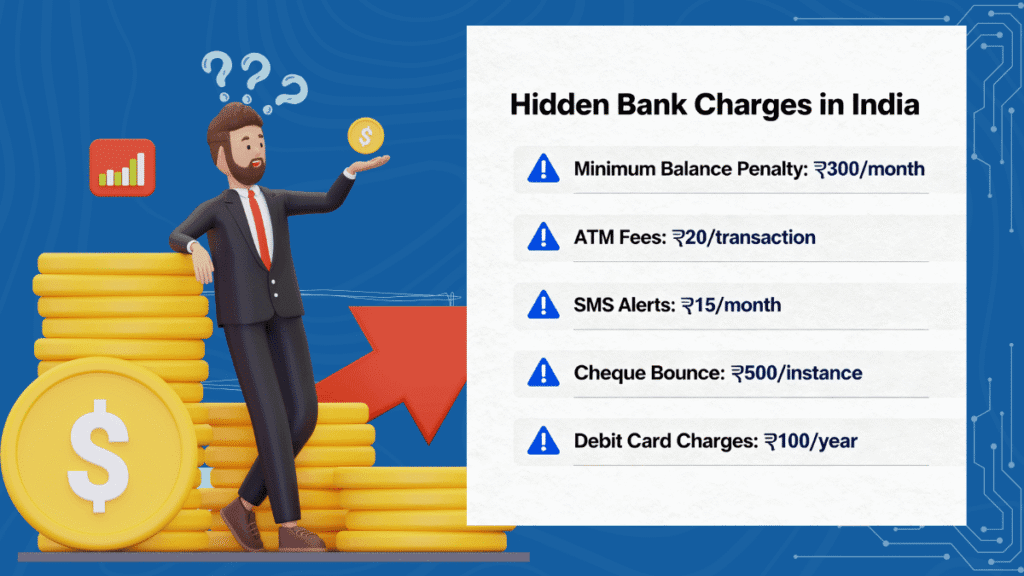
Hidden bank account charges directly impact your financial health, especially if you maintain multiple accounts or have irregular income patterns. A single minimum balance penalty can cost ₹150-₹600 per month, while exceeding ATM withdrawal limits adds ₹23 per transaction. Over a year, these seemingly small deductions can total ₹5,000-₹10,000 or more.
Understanding these charges becomes crucial for effective financial planning. When you’re aware of potential fees, you can adjust your banking habits, choose appropriate account types, and negotiate better terms with your bank. This knowledge empowers you to make informed decisions about where to keep your money and how to access banking services without unnecessary costs.
Real-Life Impact of Hidden Charges
Consider Mayesha, a 28-year-old content creator from Delhi, who discovered ₹2,115 mysteriously deducted from her account in one month. The breakdown included ₹623 for exceeding ATM limits, ₹450 in minimum balance penalties, ₹382 from UPI merchant payments, ₹510 in credit card fees, and ₹150 for cheque-related services.
Like most millennials, she had ignored the terms and conditions, assuming digital banking was cost-free. This real-world example shows how multiple small charges compound into significant amounts that could otherwise be saved or invested.
Top 13 Hidden Bank Account Charges You Must Know
1. Minimum Balance Penalty Charges
The most common hidden charge is the penalty for non-maintenance of minimum average monthly balance (AMB). Public and private sector banks require you to maintain specific balances ranging from ₹500 to ₹10,000 depending on the branch location.
Charge Structure:
- SBI: ₹5-₹15 plus GST based on shortfall percentage in rural areas; ₹10-₹15 plus GST in metro/urban branches
- HDFC Bank: ₹150-₹600 depending on balance shortfall in metro/urban branches; ₹150-₹300 in semi-urban areas
- ICICI Bank: ₹100 plus 5% of the shortfall amount in metro/urban/semi-urban locations
However, several public sector banks including Indian Bank, Punjab National Bank, and Canara Bank have waived minimum balance charges effective July 2025, providing relief to millions of customers.
2. ATM Withdrawal and Transaction Charges
Banks allow only limited free ATM transactions per month. Since May 2025, the RBI increased ATM interchange fees, raising charges from ₹21 to ₹23 per transaction beyond free limits.
Free Transaction Limits:
- Metro/urban locations: 3-5 free transactions per month
- Rural/semi-urban locations: 5 free transactions per month
- Customers maintaining ₹1 lakh or above: Unlimited free transactions at own bank ATMs
Beyond these limits, you pay ₹23 plus GST per withdrawal at non-home bank ATMs and ₹10 plus GST at your own bank’s ATMs.
3. SMS Alert and Transaction Notification Charges
Most banks charge for SMS alerts on banking transactions, though they market “free digital banking.” These charges range from ₹0.25-₹0.48 per SMS or ₹15 per quarter (₹60 annually).
Bank-wise SMS Charges:
- ICICI Bank: ₹15 per quarter plus GST
- HDFC Bank: ₹15 per quarter for savings accounts; ₹25 per quarter for current accounts
- Central Bank of India: ₹0.48 per SMS with monthly deductions
- Union Bank: ₹0.25 plus GST per SMS, maximum ₹15 plus GST per quarter
Banks are now seeking RBI permission to stop SMS alerts for transactions below ₹100 to reduce costs, though email alerts remain free.
4. Cheque Bounce Charges
Dishonoured cheques attract penalties from ₹100 to ₹750 depending on the bank and amount. Under Section 138 of the Negotiable Instruments Act, cheque bounce is also a criminal offence punishable with up to 2 years imprisonment or a fine up to twice the cheque amount.
Bank-wise Cheque Bounce Charges:
- SBI: ₹150 plus GST up to ₹1 lakh; ₹250 plus GST above ₹1 lakh; ₹500-₹1,000 for SME customers
- HDFC Bank: ₹450 for first bounce; ₹500 for second; ₹550 from third bounce onwards
- ICICI Bank: ₹200 for financial reasons; ₹500 for financial and ₹50 for non-financial reasons
- Kotak Mahindra Bank: ₹350 for first return; ₹750 from second return onwards
5. Debit Card Annual Maintenance Charges
While banks often issue debit cards “free,” annual maintenance charges (AMC) apply from the second year onwards, ranging from ₹100 to ₹500 depending on card variant.
Common Debit Card AMC:
- SBI: ₹200 plus GST for Classic cards; ₹250 plus GST for Yuva/Gold cards; ₹325 plus GST for Platinum cards
- HDFC Bank: ₹250 plus GST for Titanium/Pro-Gold cards; ₹150 plus GST for EasyShop cards
- Axis Bank: ₹200-₹300 plus GST depending on card variant
- J&K Bank: ₹100-₹150 per quarter plus GST for Platinum and World cards
6. Foreign Transaction and Currency Conversion Charges
International debit card transactions attract foreign transaction fees of 2.5%-3.5% plus currency conversion markup charges and GST.
International Transaction Charges:
- ICICI Bank: 3.5% markup plus GST; ₹125 plus 3.5% for ATM cash withdrawals abroad
- HDFC Bank: 3.5% foreign transaction fee
- SBI: 3% foreign transaction fee; ₹25 plus GST for balance enquiry; ₹100 minimum for ATM withdrawals
- Kotak Mahindra Bank: 3.5% foreign transaction fee
Dynamic Currency Conversion (DCC) adds another 1% plus GST when you opt to pay in Indian rupees at foreign merchants.
7. NEFT and RTGS Transfer Charges
While online fund transfers through net banking and mobile banking are free, branch-based NEFT and RTGS transactions attract charges.
NEFT Charges (Branch-based):
- SBI: ₹2 plus GST for up to ₹10,000; ₹4 plus GST for ₹10,000-₹1 lakh; higher for above ₹1 lakh
- HDFC Bank: ₹2-₹10 plus GST depending on amount
- ICICI Bank: ₹2.25-₹24.75 plus GST depending on amount
RTGS Charges (Branch-based):
- HDFC Bank: Flat ₹15 plus GST for all amounts
- Axis Bank: ₹25 plus GST for ₹2-5 lakh; ₹50 plus GST above ₹5 lakh
- ICICI Bank: ₹20 plus GST for ₹2-5 lakh; ₹45 plus GST above ₹5 lakh
8. Cash Deposit and Withdrawal Charges at Branches
Banks limit free cash transactions at branches to 3-4 per month. Beyond this, charges apply.
HDFC Bank Cash Deposit Charges (effective August 2025):
- Standard accounts: Free up to specified limits; ₹4 per ₹1,000 (minimum ₹50 per transaction) beyond limits
- Low denomination notes (₹20 and below): No free limit; 5% of cash deposit in coins
Kotak Mahindra Bank: Earlier allowed 5 free cash deposits up to ₹7.5 lakh per month; now reduced to 4 transactions up to ₹2 lakh with ₹150 minimum charge beyond limits.
9. Cheque Book Issuance Charges
After exhausting the free cheque leaves provided initially, banks charge ₹100-₹150 for additional cheque books (typically 25 leaves).
Typical Charges:
- Most banks: ₹100 plus GST for 25-leaf cheque book
- Premium accounts: Often receive free cheque books
- Basic Savings Bank Deposit Accounts (BSBDA): One free cheque book of 25 leaves per year for senior citizens and differently-abled persons
10. Account Closure Charges
Closing your savings account within the first year attracts penalties ranging from ₹200 to ₹500 plus GST.
Bank-wise Closure Charges:
- HDFC Bank: No charge within 14 days; ₹500 (₹300 for senior citizens) between 15 days to 12 months; free after 12 months
- SBI: No charge within 15 days; ₹500 plus GST between 15 days to 1 year; free after 1 year
- ICICI Bank: No charge within 30 days; ₹500 between 31 days to 1 year; free after 1 year
- Canara Bank: No charge within 14 days; ₹200 plus GST within 1 year; ₹100 plus GST after 1 year
11. Dormant Account Reactivation Charges
Accounts with no customer-initiated transactions for over 2 years become dormant. While RBI guidelines state banks cannot charge penalties on dormant accounts, some banks charge reactivation fees ranging from ₹1,500 to ₹2,500.
However, most major banks including SBI, HDFC Bank, and ICICI Bank do not charge for reactivating dormant accounts as per current RBI norms.
12. Physical Statement and Passbook Charges
Requesting duplicate account statements or physical copies attracts charges:
- Duplicate statements: ₹100 plus GST per statement (typically 40 entries)
- Statement copies for past periods: ₹50-₹100 per page depending on bank
Digital statements via email remain free across most banks.
13. Balance Inquiry Charges at ATMs
Each balance inquiry at another bank’s ATM counts toward your free transaction limit. Once exhausted, balance inquiries cost ₹8-₹10 plus GST at own bank ATMs and ₹10 plus GST at other bank ATMs.