
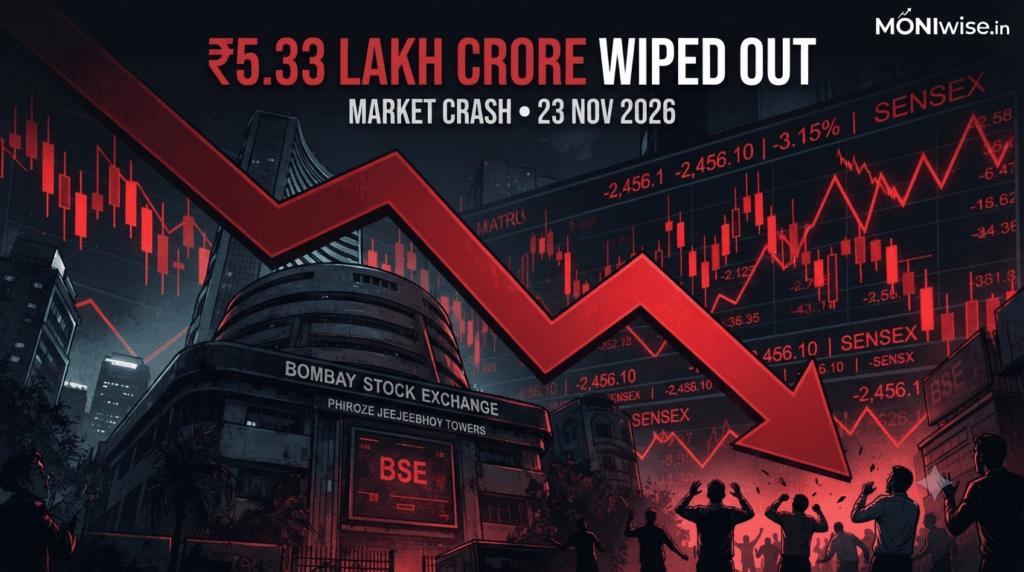
Market update: Monday, 23 November 2026 | Figures updated to 1:27 PM IST
A promising Monday morning turned into a nightmare for thousands of Indian stock market investors.
The Sensex plunged more than 1,100 points. Nifty 50 slipped below 25,500. And approximately ₹5.33 lakh crore in stock market value disappeared during the trading session.
What makes this fall particularly unsettling is how quickly market sentiment reversed. Indian benchmark indices opened higher, suggesting another positive session. Within hours, selling pressure in banking, metals and other heavyweight stocks had wiped out those early gains.
Meanwhile, the shock from last week’s brutal technology stock sell-off in the United States continued to unsettle Asian markets.
The big question now is simple: Is this just temporary profit booking, or is a larger stock market correction beginning?
Let’s examine what happened, why markets are falling, which stocks are under pressure, and how fear can make a bad trading day even worse.
Stock Market Crash Today: What Happened on November 23, 2026?
Monday’s trading session delivered a painful reversal for Indian equities.
After opening with gains of approximately 0.8%, the Sensex and Nifty reversed direction as traders began selling stocks that had rallied strongly during November.
By 1:27 PM IST, the damage was significant.
| Market indicator | Intraday position |
|---|---|
| BSE Sensex | 82,760.74 |
| Sensex decline | 1,159 points (-1.38%) |
| Nifty 50 | 25,449.90 |
| Nifty decline | 351 points (-1.36%) |
| BSE-listed companies’ market value decline | Approximately ₹5.33 lakh crore |
| Most affected sectors | Metals, banking and financial services |
Source: Times of India market report updated at 1:30 PM IST, November 23, 2026. All figures are intraday and may change before the market closes.
The broader market also weakened, with mid-cap and small-cap indices entering negative territory.
A market that appeared confident at the opening bell suddenly looked nervous.
This sharp change matters because investors who purchased stocks during the morning rally may have found themselves holding losing positions only hours later.
Did investors really lose ₹5.33 lakh crore?
The widely reported ₹5.33 lakh crore figure represents a reduction in the combined market capitalisation of BSE-listed companies.
It does not mean that ₹5.33 lakh crore in cash was physically withdrawn from the market.
When share prices decline, the market value of outstanding shares decreases. Some investors may realise losses by selling; others continue holding their investments.
Nevertheless, such a substantial fall in market value reflects how rapidly investor confidence and asset prices can change.
Why Is the Stock Market Falling Today? Five Major Reasons
There is rarely one explanation for a major stock market decline. Today’s sell-off appears to reflect several pressures arriving together.
1. Profit booking after a powerful Indian stock market rally
One of the biggest reasons is profit booking.
According to Reuters, Indian benchmark indices had gained substantially during November before Monday’s decline. The Nifty 50 and Sensex were still up approximately 11.4% and 12.2%, respectively, for the month at the time of its report.
Banking and financial shares had also recorded particularly strong gains during the preceding four weeks.
After such a rapid rise, some investors naturally decide to secure profits.
The danger begins when selling spreads beyond a few expensive stocks.
As prices start falling, other traders may become nervous and sell their holdings too. A routine correction can then turn into a much sharper intraday decline.
The market does not need terrible economic news to fall. Sometimes, excessive optimism creates its own vulnerability.
2. Banking heavyweights drag Sensex and Nifty lower
Banking shares emerged as major contributors to Monday’s decline.
Stocks including HDFC Bank, ICICI Bank, Axis Bank and State Bank of India faced selling pressure.
Why do bank stocks matter so much?
Major banks carry substantial weight in Indian benchmark indices. When several heavyweights fall simultaneously, their combined impact can drag the entire index lower.
The selling also followed a strong rally in banking shares, making the sector vulnerable to profit-taking.
For investors watching the Nifty or Sensex, this creates an important distinction: an index can fall sharply even when some individual stocks are rising.
3. The global AI stock sell-off shakes investor confidence
The second major story is unfolding outside India.
The United States experienced a severe technology-led market sell-off during the previous week.
On Friday, November 20, the S&P 500 declined approximately 3.7%, while the technology-heavy Nasdaq Composite fell roughly 5.3%.
According to Reuters, the Nasdaq had suffered its worst weekly decline since March 2020.
The pressure was particularly intense in companies associated with artificial intelligence, semiconductor manufacturing and the enormous investment required to construct AI data centres.
Investors are becoming increasingly concerned about whether the money being spent on AI infrastructure will generate enough future profits to justify elevated valuations and borrowing.
When those expectations change, even previously popular growth stocks can face aggressive selling.
The damage can then spread internationally through changing risk appetite, institutional portfolio adjustments and global fund flows.
4. US interest-rate concerns return
Another pressure point is uncertainty about the Federal Reserve’s monetary policy.
Concerns about further US interest-rate increases have weighed on international investor sentiment.
Higher interest rates can increase borrowing costs, reduce the present value investors assign to future corporate earnings and make relatively safer interest-bearing investments more attractive.
Technology companies with ambitious expansion plans can be particularly sensitive to these changes.
Emerging markets such as India may also feel pressure when investors reassess their exposure to riskier assets.
However, interest-rate expectations can change quickly as new economic data arrives.
5. Weak rupee and selling in metal stocks
The Indian rupee weakened against the US dollar on Monday, adding to market concerns.
A weaker rupee can increase costs for import-dependent businesses and complicate foreign investors’ currency-adjusted returns.
Metal stocks also faced significant selling pressure amid changes in global commodity prices and investor expectations for industrial demand.
For Indian investors, the combination of weakness in banks, metals and other large companies created a difficult trading environment.
Global Stock Market Sell-Off: What Happened Around the World?
The nervousness extended beyond Dalal Street, although the declines were not universal.
United States: A brutal Friday, followed by a futures rebound
US markets ended the previous week under heavy pressure.
Major technology shares were hit as investors questioned the sustainability of the AI spending boom.
However, US stock-index futures recovered on Monday morning, with S&P 500 futures rising around 2% and Nasdaq 100 futures gaining close to 3% in early trading.
That rebound is important.
It suggests investors were responding differently to the previous week’s sharp sell-off, and that Monday’s global market action was not an uninterrupted collapse everywhere.
A positive futures opening, however, does not guarantee that the regular US trading session will finish higher.
South Korea: Chip stocks remain under pressure
South Korea’s Kospi suffered another difficult session as concerns about technology and semiconductor valuations persisted.
The index was down approximately 3.3% at one stage reported by AP, while major chip-related companies such as Samsung Electronics and SK Hynix also traded lower.
Because these companies are closely connected to global semiconductor demand, their performance is often watched as an indicator of technology-sector sentiment.
Taiwan: A recovery despite global concerns
Taiwan provided an important contrast.
Its benchmark Taiex index rose approximately 2.2% in AP’s market update, while TSMC also gained.
This recovery demonstrates why it would be inaccurate to describe November 23 as a day when every stock exchange crashed.
Other Asian and European markets
Hong Kong and Australia experienced modest weakness in early reporting, while other regional markets showed mixed movements.
Japan’s stock market was closed for a public holiday.
European markets were also showing signs of stabilisation as trading began, rather than suffering uniform declines.
The bigger global story is not that every market is crashing. It is that fear surrounding the AI trade has spread across borders, while investors are struggling to determine which assets remain attractive.
Which Indian Stocks and Sectors Were Hit Hardest?
Several influential Indian companies came under pressure during the session.
Among the names affected were:
- Tata Steel: significant weakness amid broader metal-sector selling and company-specific developments.
- HDFC Bank: selling in a major index heavyweight.
- ICICI Bank and Axis Bank: pressure across large private-sector lenders.
- State Bank of India: weakness in the banking sector.
- UltraTech Cement: among the large stocks facing selling pressure.
Not every major stock declined.
IT companies including TCS, Infosys, Tech Mahindra and HCL Tech were among the stocks trading higher in the afternoon report.
This difference is significant because it shows that investors were not abandoning every sector equally.
Some investors may have been rotating money between sectors rather than simply exiting equities altogether.
Mindwise Special: Why a Falling Market Makes Investors Panic
A market crash is not only a financial event.
It is also a psychological test.
The sight of red numbers, declining portfolio values and alarming headlines can push investors into decisions they would never make under normal circumstances.
Here are five psychological traps that become especially dangerous during a market sell-off.
1. Loss aversion: The fear of losing becomes stronger than logic
Imagine an investor whose portfolio was worth ₹10 lakh before a market decline.
After a sharp correction, its value falls to ₹9.3 lakh.
That investor may suddenly become obsessed with the ₹70,000 reduction.
Instead of reviewing the quality of the investments, the investor begins thinking:
What if I lose another ₹1 lakh tomorrow?
That fear may encourage an immediate sale even when the investor originally planned to hold for several years.
Loss aversion describes our tendency to react strongly to losses. It can make short-term market movements feel more threatening than their actual impact on long-term plans.
2. Herd mentality: Everyone is selling, so should I?
During market declines, investors frequently look to other people’s actions for reassurance.
If social media is filled with warnings about a major crash, selling can begin to appear like the safest decision.
But popularity does not make a financial decision correct.
Following the crowd without understanding valuations, fundamentals or personal risk tolerance can lead to buying during excessive optimism and selling during excessive fear.
3. Anchoring: Refusing to accept a changing market
Suppose an investor bought a stock at ₹500, watched it rise to ₹650, and then saw it fall to ₹540.
The investor may remain convinced that ₹650 is the stock’s true value simply because it traded there recently.
That previous high becomes a psychological anchor.
But market prices respond to future expectations, not an investor’s preferred reference point.
The right question is not merely whether the share has fallen from its high.
It is whether the company’s prospects, valuation and associated risks still justify holding it.
4. Revenge trading: Trying to recover losses immediately
This is particularly dangerous for intraday and F&O traders.
A trader suffers a loss in the morning and decides to recover it before market close.
Position sizes increase. Stop-loss rules are ignored. Trades become emotional instead of systematic.
A difficult day can quickly turn into a much larger financial setback.
The market does not owe anyone a recovery trade.
For a deeper explanation, read our guide on Why Traders Fail: 7 Key Reasons & How to Avoid Them in India.
5. False confidence: Assuming every fall is a buying opportunity
The opposite of panic selling can be equally dangerous.
Some investors believe that every sharp decline automatically creates a bargain.
They begin buying aggressively without checking earnings expectations, debt, valuations or whether market conditions have materially changed.
A stock that has fallen 20% can fall further.
A lower price is not necessarily a reasonable valuation.
Is This a Market Crash or a Normal Correction?
The term “market crash” attracts attention, particularly during dramatic intraday declines.
But investors should distinguish between different kinds of market weakness.
A pullback is a relatively modest retreat after prices rise.
A correction commonly refers to a decline of at least 10% from a recent peak.
A bear market is commonly associated with a decline of 20% or more from a recent high.
A crash describes an unusually sudden and severe fall, but it does not have one universally accepted percentage threshold.
Monday’s sharp Indian intraday decline was serious, yet it does not by itself establish that Indian equities have entered a prolonged bear market.
This distinction matters because emotionally powerful headlines can make a one-day fall feel like the beginning of a financial disaster.
The next several sessions, market breadth, institutional flows and changes in economic expectations will provide more evidence.
What Should Investors Do During a Stock Market Sell-Off?
There is no single response suitable for every investor.
A long-term investor with diversified holdings faces different decisions from an intraday trader using leverage.
Still, these steps can help prevent avoidable errors.
For long-term investors
- Review investment fundamentals. Check whether company earnings, debt, competitive position or long-term prospects have actually changed.
- Reassess portfolio concentration. Too much exposure to one stock or sector increases risk.
- Protect short-term financial needs. Money required soon should not depend on an immediate equity-market recovery.
- Avoid impulsive portfolio changes. A decision made in panic may contradict a carefully designed investment plan.
- Maintain realistic expectations. Equities can experience extended declines, even when long-term prospects remain favourable.
Investors considering diversified funds can also read our Index Fund vs Mutual Fund India guide.
For intraday traders
- Do not increase leverage simply because the market is volatile.
- Respect predetermined position-sizing and stop-loss rules.
- Avoid repeatedly reversing positions after every sharp price move.
- Reassess spreads, liquidity and volatility before entering trades.
- Consider staying out when market conditions do not match the trading strategy.
Beginners should first understand the risks explained in our Beginner’s Guide to Stock Trading.
What Could Happen Next? Key Market Signals to Watch
No one can reliably predict the next trading day’s market direction.
However, investors can monitor developments that may influence sentiment.
1. US technology stocks
The performance of major AI-related companies and semiconductor stocks will remain important given the role technology selling has played in the global downturn.
2. Nifty 50 around 25,500
The 25,500 area is an immediate reference point because the index moved below it during Monday’s decline.
Traders may watch whether the index recovers and sustains itself above this area or remains under selling pressure.
This is an observation point, not a guaranteed support or resistance level.
3. Banking and metal sector performance
A stabilisation in large banks and metal stocks could help improve broader Indian market sentiment.
Continued weakness would remain an area of concern.
4. Foreign institutional investment flows
Reuters reported substantial foreign buying in Indian equities earlier in November.
Whether those flows continue or reverse could influence the durability of the recent Indian market rally.
5. Volatility and global monetary policy
Changes in India VIX, global bond yields, currency markets and Federal Reserve expectations can provide further clues about investors’ willingness to take risks.
None of these signals should be treated as a standalone buy or sell instruction.
The Hidden Lesson of November 23: Markets Can Change Faster Than Your Conviction
Perhaps the most important lesson from today’s session is how quickly confidence can disappear.
A stock market that looked strong during the morning can become uncomfortable for investors by lunchtime.
Profits that appeared secure can turn into losses on paper.
A popular sector can suddenly face aggressive selling.
And traders who believed they understood the direction of the market may discover that their positions were built around assumptions rather than risk controls.
Markets have always moved through cycles of enthusiasm, uncertainty, fear and recovery.
The challenge is not to predict every turning point.
It is to avoid making decisions that leave you financially vulnerable when the unexpected happens.
Frequently Asked Questions
Why is the Indian stock market crashing today?
The Indian market fell on November 23, 2026, amid profit booking after a strong rally, selling in major banks and metal stocks, global technology-market uncertainty, a weaker rupee and concerns about US interest rates.
How much did investors lose on November 23, 2026?
By approximately 1:27 PM IST, the combined market capitalisation of BSE-listed companies had fallen by around ₹5.33 lakh crore. This was an intraday reduction in market value, not an amount of cash physically withdrawn.
Is the global stock market crashing today?
Several markets experienced significant weakness, particularly after the US technology sell-off. However, some markets and futures indices recovered on November 23, so it is inaccurate to say every global stock exchange was falling.
Will Nifty fall further tomorrow?
The next day’s direction is uncertain. Investors should monitor banking stocks, global technology sentiment, foreign investment flows and price action rather than relying on a guaranteed prediction.
Should investors sell all their stocks during a market crash?
A broad sell-off alone is not a sufficient reason for every investor to liquidate their portfolio. Decisions should reflect investment goals, company fundamentals, liquidity requirements, diversification and risk tolerance.
Is it safe to buy stocks after a major fall?
A sharp decline can create opportunities in some assets, but it can also reflect deteriorating business conditions or valuations that remain excessive. Buying solely because prices have fallen is risky.
Final Thoughts: The Market Is Falling, but Panic Can Be More Expensive
November 23, 2026, has demonstrated how quickly global financial anxiety can reach Indian stock markets.
The Sensex fell more than 1,100 points by the early afternoon. Nifty dropped below 25,500. Approximately ₹5.33 lakh crore in listed market value was erased.
Behind those headline numbers lie several interconnected forces: profit taking, weak banking shares, a retreat from expensive AI-related stocks, interest-rate uncertainty and changing investor confidence.
Whether this develops into a deeper correction remains unknown.
But one lesson is already clear.
The most damaging market decisions are often made when fear replaces preparation.
Follow Moniwise.in for financial education, market explainers and practical insights into smarter investing.
Market data note: This article reflects information available during the Indian trading session on November 23, 2026. Prices and market capitalisation figures are not closing values.
Disclaimer: This content is for educational and informational purposes only. It does not constitute personalised investment advice or a recommendation to buy or sell securities. Equity and derivatives trading involve significant financial risks.